Resources

This page has resources that will help you realise your cohousing dream. It also has policy and advocacy resources for decision-makers or for cohousing communities who may be approaching their local council or member of parliament.

We want to continuously improve these resources and so value your feedback. Also, if you have resources that you want to share email us at research@cohousing.org.au and we will be in touch about how best they can be used and shared with others.
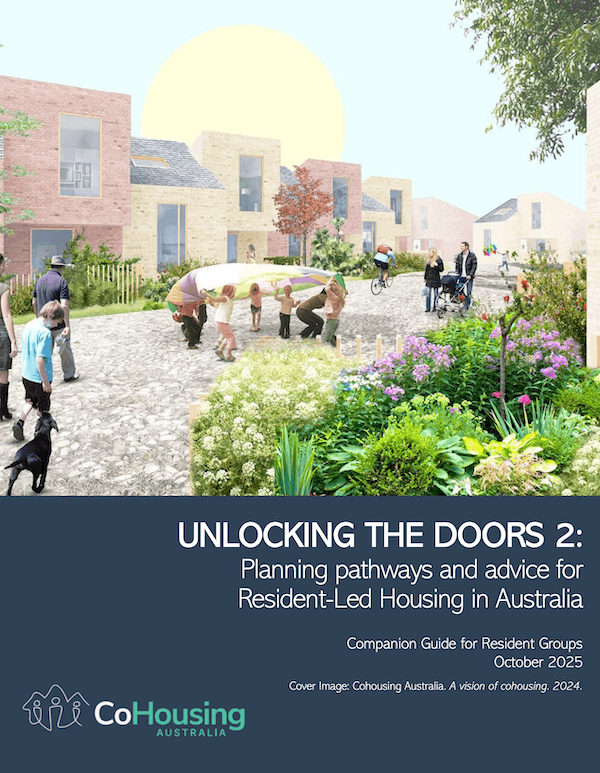
Unlocking the Doors: Planning Pathways and Advice for Resident-Led Housing

unlocking the door image

This guide follows on from our earlier publication, Unlocking the Doors: Legal and Financial Pathways to Resident-Led Housing. It is designed to support prospective cohousing members through the planning stages of development, helping groups navigate practical steps and strategies for working within Australia’s planning system. The content is based on research and consultation with resident groups and experts in the field. The Guide is designed to be used as a practical workbook — a tool to test, adapt, and refine as your project evolves. The guide works best when used alongside the many helpful resources already available. Be sure to make use of the hyperlinks provided throughout the guide for further information, case studies, and state-specific resources—many of which are included in the appendix.

This guide is for people wanting to set up collaborative housing in Australia. It is based on research and consultation with resident groups and experts in the field.

You can download the guide Unlocking Doors Planning Pathways

You can view a summary presentation of the Guide Summary

We encourage groups to share their experiences and feedback so that future editions can continue to improve and reflect the collective knowledge of Australia’s cohousing and collaborative housing community.

Please send feedback to planningpolicy@cohousing.org.au
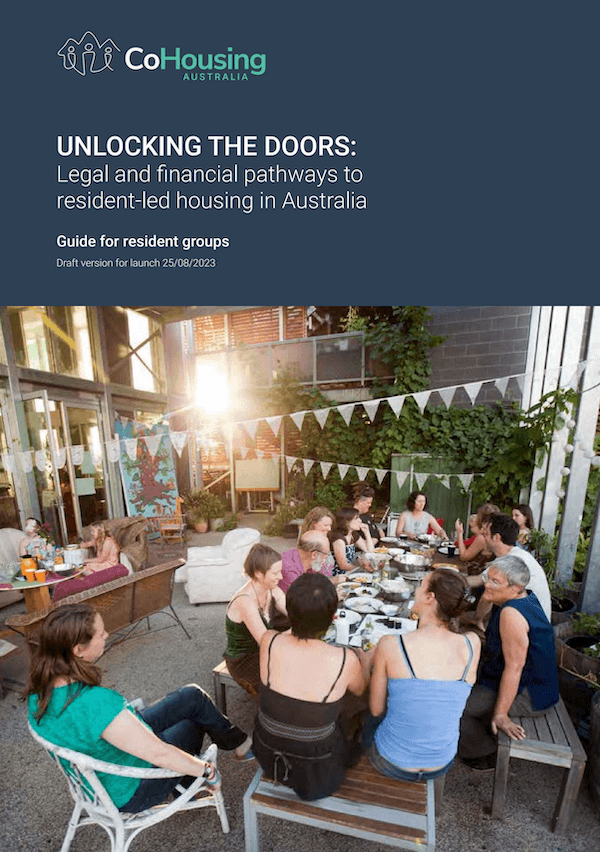
Unlocking the doors: legal and financial pathways to resident-led housing

Unlocking the doors: legal and financial pathways to resident-led housing document front page

A guide produced for CoHousing Australia through a Knowledge Exchange Grant from the City of Sydney. Ms Caitlin McGee from the Institute of Sustainable Futures at the University of Technology and Dr Matt Daly from the Sustainable Building Research Centre at the University of Wollongong interviewed cohousing groups, property developers, and finance sector representatives about how to make cohousing a reality in Australia.

This guide is for people wanting to set up collaborative housing in Australia. It is based on research and consultation with resident groups and experts in the field.

We hope the guide becomes used by groups like a workbook that you use and test thoroughly.

We want it to be a circular guide where your experience of using it is fed back for us to update and improve on so that all cohousing and collaborative housing groups can benefit.

For now, please email feedback to research@cohousing.org.au with the subject line: Cohousing guide feedback. In future, we hope to make the guide available on a platform in which collaborative housing groups can provide feedback and share resources and useful experience.

The guide was launched on Friday 25 August 2023 at the ResHub (Research Hub) at UTS.

How Feasible is a New Generation of Housing Co-operatives in Australia?

unlocking the door image

In this study we investigate whether it is feasible today for a non-subsidised co-operative model of housing to deliver affordable and secure tenure housing for moderate income workers. A segment of our society who are increasingly priced out of ownership throughout great swathes of urban and regional Australia.

With a particular focus on “missing middle” income cohorts who are not able to access social and affordable housing, or afford premium Build To Rent, we look at how “limited equity” housing co-operatives, which work successfully throughout Europe in cities like Zurich, and Vienna, as well as North America in cities like Toronto and New York, could be adopted as an affordable housing solution in an Australian context.

We also explore the cost of including cohousing features such as common rooms for collaborative activities. This helps explore the question of the dollar value we place on community spaces in an inner city urban environment and who should foot the bill?

We hope the findings and questions posed through this work spark a conversation about how we can practically create a new housing solution (a “third way” or “middle ground” between ownership and rental) for this critical and increasingly financially stressed segment of Australian society.

This report was made possible by the Business Council of Co-operatives & Mutuals (BCCM) via a Bunya Fund grant.

How to Guides

Stage 1: How to Start a Group

Finding Others:

  • Dinner parties, community meeting, social media

  • Send out a cohousing survey: Capture data and invite participants to a meeting; proforma survey questions:

  • Create a project group

  • Financial capacity: Everyone is going to have to be open to having an independent financial assessment done to establish their individual capacity to participate in the project.

  • Meet regularly: Meeting to further the work

  • Self Selection

  • We all wear different masks for different contexts and it can be easy to adopt these in different contexts – home, friends, work, hobbies. Cohousing presents an interest context where one might be engaging with many different people in many different forums

  • The difficult people: Remember sometimes you are the difficult person

  • Decision making: Consensus, Sociocracy

  • Communication: Non-violent communication, Communication Policy

  • Organisational Structure: Non-hierarchical, Subgroups and working committees, The kids group

  • The martre: It is good to do a review or audit at regular intervals to get a sense of how people are feeling about the process being used and the operational experience on the ground.

Stage 2: How to Find a Site

Put yourselves out there:

  • Host a community meeting explaining to your local area that you are looking for land and do they have any, know someone, have seen the perfect site.

  • Go to local real estate agents and explain to them what you are looking for.

When considering a site, think about:

  • Where you want to be, what you want to be near?

  • What typology are you interested in?

  • Do your due diligence

  • Secure funding

  • Purchase the site

  • Understand the planning restrictions

Stage 3: How to Get It Built

Do it all yourself. This is only for the really capable and experienced group:

  • Do you have all the specialist consultants or the capacity to engage them? (See our consultants page)

  • Can you organise construction finance?

Partner with a developer. Many groups quickly realise that they don’t have all the skills and or time to undertake a design and development project of this scale. That’s ok! It is important to ask for help, it’s one of the reasons you are interested in cohousing. This is just another opportunity to build relationships. Finding a developer:

  • This can be a scary process and it is important you have a good idea about what it is you are trying to establish

  • Have a strong sense of your collective objectives for the project

  • Have a solid decision making process in place

Questions to ask prospective developers:

  • Do you understand what cohousing is?

  • Have you worked with large stakeholder groups before? What is your process for this?

  • Look at other projects they have done; do they meet your expectations; ESD, finishes

  • Who do they bank with?

  • Who carries the risk?

  • Who are the consultants that they use?

  • Do you have a choice in who your architect is?

Partnering with a Non-profit Developer (ie Community Housing Provider). This can bAs with other development partners it is important to ensure you have a good understanding of what you want to active and how you might work collaboratively with a NFP/CHP. Partnership Configurations:

  • NFP/CHP owns the land and develops the project: Cohousing participants purchase their individual dwellings off the NFP/CHP who maintain ownership of a percentage of the dwellings for their tenants. It is important that the cohousing initiators have a clear contractual agreement on their level of participation in the design and development process, and a clear idea of the purchase price. Make sure you also have established agreements on the post occupancy management of the project.

  • Joint venture partnership: You establish a breakdown of joint venturers

Stage 4-5: Participatory Design and Living Together

  • What is Participatory Design?

  • Finding an Architect

  • Council approval: Build a relationship with your Council, Check if Council regulations align, Create the right consultant team, Liaise with Council during the design process

  • Tips and Tricks: Before you start have a decision making process.

Construction:

  • Monitor construction work

  • Self-educate – construction types and their characteristics

  • Decide on a type of construction

  • Investigate and secure funding

  • Entering into contracts

  • Secure mortgage loans for buyers

Living together:

  • How do we manage the property?

  • How do we make decisions?

  • Repairs and maintenance

  • Re-sale policy

Planning Support for Cohousing

Cohousing enables community living through a mix of private and communal spaces and facilities with independent dwellings, and governance that promotes regular resident contact and sharing. This document lists some of the current planning instruments that could be used to support Cohousing. The discussion points to the barriers to the development of Cohousing in Victoria and especially Melbourne.

The document highlights ways to use planning documents, instruments and processes to facilitate cohousing, and the need for a definition that can support emerging statutory instruments. The lists are by no means exhaustive, but do illustrate the type of problems faced by innovative developments other than the typical detached house on a suburban block, townhouses or apartment buildings.

Section 1: Provide a Policy and Strategic Planning Context for Cohousing

Local Councils have a number of instruments that are legislative requirements and direct local planning. These include the Council Plan, Municipal Strategic Statement (MSS), Housing Strategy, and Health and Well Being Plan. An Affordable Housing Policy can provide for localised analyses and identify specific actions. These can be used to make reference to Cohousing models contributing to address key issues such as lack of housing diversity, housing affordability, rising costs of living, social isolation, community cohesion and resilience, environmentally sustainable housing and households, and safety and security. Such documents are generally referenced in Local Planning Schemes but unless specific policy, schedules or other planning instruments are included in the Council’s MSS or other planning tools (e.g. schedules to zones, overlays, provisions) they are not afforded a high status in appeals to VCAT.

Structure Plans, Masterplans, Urban Design framework and rezoning requirements (when residential densities are being increased) can be used to designate precincts for and/or support Cohousing in other ways. They can allow for identifying specific sites (underutilised public or private land) deemed suitable for cohousing development (adjoining parkland, public transport corridors, close to retail, commercial and community facilities). They can provide specific requirements and/or guidelines (such as minimal car parking but optimum bike storage requirements, and allowing communal water, waste and energy service systems) to promote and support cohousing (e.g. Heidelberg West and Bellfield Structure Plan, Banyule Council, Kananook Green Link Masterplan, Frankston Council).

Section 2: Provide Supportive Planning Tools

Inclusionary zoning allows developers of new residential projects to get additional density and requires them to set aside a certain percentage of the development as affordable. Developers are required to incorporate a certain proportion of affordable housing in a development project, or make a cash contribution for an equivalent quantum and standard of affordable housing to be provided elsewhere in the neighbourhood in question. DELWP is currently piloting six sites across Victoria. Amendment GC81 Fisherman’s Bend’s concept of Floor Area Uplifts and Public Benefit calculationscan achieve similar outcomes. Cohousing can be specified as means to achieve inclusionary goals.

Relax on-site waste collection requirements for cohousing developments where residents are committed to jointly minimising the amount of wasteneeding to be collected.

Change general requirements around parking (number of car spaces per dwelling) and vehicle access to reduce extent of driveways. Allow verges to be used for share scheme car parking provided it does not interfere with street trees. Waiver carparking where Green Travel Plans are in place.

Provide exemptions from developer contributions by including planning permit conditions that will enable an exemption (Banyule Council Planning Scheme Amendment C115).

Reduce third party appeal rights if all requirements are met.

Provide for assessments to allow shared community facilities and open spaces to be included in assessments of individual dwellings.

Include legal agreements attached to permit applicationsto cap profit margins.

Provide incentives where owners consolidate sites to achieve greater social and environmental outcomes.

Reduce minimum dwelling sizes to allow for‘tiny houses’ and micro-apartments if part of Cohousing.

Use Voluntary Affordable Housing Agreementsto lever involvement of local government, housing associations, not for profits.

Cohousing developments must include the creation of a legal entity (e.g. incorporated association) with responsibilities for the following:

  • Binding Maintenance Agreementbetween residents for their effective management, maintenance and use of all shared spaces;

  • Binding Green Travel Plan(A Green Travel Plan (GTP) sets out a plan designed to encourage the use of more sustainable modes of transport. The plan typically includes targets and actions for a new development to promote walking, cycling and the use of public transport and carpooling. ) between residents to enable shared-car use, bike use and public transport use; and

  • Maintenance Agreement & Green Travel Plan attached to titleand periodically reviewed by a legally constituted entity.

  • Commitment to prepare and complete (via planning permit conditions) the above agreements and plans before the development is occupied.

Section 3: Provide Incentives to Support Planning Processes

  • Provide pre-permit application advice early in the planning process to assist citizen led Cohousing processes, including officer training to ensure an understanding of how deliberative models differ from conventional models.

  • Provide a fast track process through planning application to expedite planning permit processes and keeps open dialogue across council departments at all stages of the process. Setting a framework for assessing developments that includes community benefit elements and provide incentives including additional preapplication meetings, access to senior staff and guaranteed decision by Council Officers, rather than at a Council meeting, resulting in a potential time saving of 4 to 6 weeks.

  • Provide incentives for local councils to support cohousing development (e.g. funding for planning scheme amendments, funding for community engagement and education, and/or funding for pilot projects. Download Moreland's Design Excellence Scorecard

  • Provide one stop shop approach to coordinate all inputs/processes in non linear way, including assistance with liaison to referral authorities and utility agencies (e.g. VicRoads, heritage, energy/water agencies.

  • Reduce permit application fees, including considering an exemption from the Metropolitan Planning Levy (MPL).

  • Provide an Independent Review Design Panel containing professionals experienced in Cohousing (e.g. draw from Cohousing Australia) or provide for projects to be referred to the Office of the State Government Architect (OSGA)’s Design Review Panel (VDRP). The VDRP panellist are experienced professional specialists in the built environment.'

  • Provide a demonstration project to show what is possible and highlight the differences between conventional and Cohousing models.

  • Reserve Council and/or State owned landin locations that support providing shared spaces adaptable live/work spaces, reduced reliance on car use, and close to amenities.

  • Put in place a set of pre-requisites prepared by Councilwhich any Cohousing development would need to meet, these could range of design excellence and environmental features through to extent of shared/public spaces and affordability.

  • Sell council land at a rate less than market valueor with favorable contractual terms (such as deferred payment terms) to those seeking to deliver a Cohousing development project. The level of land reduction could be closely tied to how well the proposed project meets the criteria and the level of ‘public good’ to be achieved with an emphasis on affordability.

  • Considerlong term leases on Council/public/non for profit land with public housing peppercorn or greatly reduced; and private units (owned or rented) component at market rental value.

Section 4: Integrate Cohousing Definition into Land Use Terms at a State Level

Cohousing is not defined by the planning scheme and, due to the variety of possible approaches to Cohousing developments, definitive elements will ensure that only genuinely socially responsible groups gain exemptions and incentives, and that the inclusion of Cohousing does not create a ‘loophole’ for developers to exploit. Given the critical role land use terms play in the planning system, the inclusion of Cohousing as a distinctive and well-defined addition to residential development typography is required to facilitate its formal development both for establishing groups and for planning approval processes.

A definition of Cohousing is required to:

  • Provide for linking to a zone such as inclusionary zone, value uplift overlays and other such emerging planning tools.

  • Give the basis for dealing with car parking exemptions/specific requirements e.g. Green Travel plans, share care scheme.

  • Give prominence to identifying and supporting positive social and environmental amenity outcomes.

  • Provide the strategic basis for listing Cohousing developments exemptions e.g. from Developer/Development Contributions, third party appeal rights.

The definition needs to:

  • Clearly demonstrate the core distinctions of the cohousing model from other multi-residential development types. Key to this are elements identified in Creating CohousingBuilding Sustainable Communities (by K. McCamant and C. Durrett, New Society Publishers, 2011), including that the residential group establishing the cohousing project:

  • Participates fully in the project design that, in turn, will facilitate community use and interaction.

  • Is legally a co-governing organisation with clearly stated participatory co-management processes.

  • Includes numerous and various communal facilities (such as laundries, coworking and storage areas) that either substitute for single household facilities, or extend and expand their amenities.

  • Be specific enough to clearly distinguish cohousing as a housing typology that provides sufficient social, environmental and economic benefits to the broader community to warrant an exemption. (Cohousing communities often allow interested neighbours to become members of their community food garden and coworking spaces, food cooperative buying schemes and central spaces for meetings and other gatherings. Consider use of broad and flexibly applied ‘design principles’ and planning provisions.

  • Be succinct and robust so they can roll back into statutory planning processes.

  • Be listed as a separate land use under accommodation.

  • Be included as part of the discussion and exploration of broadening the concept of providing “more diverse housing” to go beyond unit sizes, physical form, density to include delivery models (alternatives to conventional speculative models), tenure types(e.g. community trusts, cooperatives) community benefits.

Section 5: Other Actions to Complement and Support Planning

  • Build understandingof the social (community), environmental and economic benefits of cohousing:

  • Environmental sustainability– elements such as green infrastructure, onsite power generation, reduced private car ownership and use, community food growth, and passive environmental design;

  • Social sustainability– elements such as shared community space, shared laundry facilities, well considered internal circulation, optimisation of development size to improve community cohesion and greater participation by home-seeker; and

  • Financial sustainability– elements such as capped developer profits, pared down internal fit out, and affordable housing for residents.

  • Facilitate partnershipsand collaboration to set up pilot projects: especially providing opportunities for Housing Associations and Disability providers.

  • Promote alternative housing delivery modelsthat increase affordability and provide social and environmental benefits (including self-build, modular, prefab and tiny houses/units).

  • Promote existing and emerging Cohousing models including testimonials of those living in, research on processes, benefits and requirements.

  • Provide financial support via grant funding, access to subsidised land, and promotion of financial mechanisms to support the establishment of Cohousing.

  • Provide public land for projects that support the social, cultural and urban planning goals of the city with incentives such as deferring payments until groups have fully formed and have planning approval. When selling public land on open market include a requirement for Cohousing. This could include air rights and colocating with public community infrastructure.'

  • Provide training and support to build capacityin communities to leverage opportunities to help build liveable cities. Including training cooperative management models (e.g. sociocracy), developing binding Maintenance Agreements (between residents for their effective maintenance and use of all shared spaces) and Green Travel Plans (agreements between residents to encourage shared-car use, bike use and public transport use).

  • Provide assessment guidelines and training(as have been developed for ESD) showing how the planning system can facilitate positive amenity outcome not just focus on dealing with the adverse amenity potential.

  • Reduce lease variation charges and stamp duty on urban infill projects which are initiated by not-for-profit, resident-managed organisations.

Encourage Local Councils to advocate for cohousing including running information sessions, hosting workshops, and sharing information through their publications and social media. Creating a location where people can register interest and/or be linked to other groups.

Webinars

Past webinar records on various cohousing topics. Schedule for future webinars is updated regularly.

June 2021 - NENA Housing Week

NENA Housing Week featured two professional session in the area of Cohousing, discussing the availability, affordability, design and sustainability of Australia’s housing and human settlements. One of the goals of the Housing Roundtable discussion is discuessed to identify key actions to include in NENA’s Civil Society Strategy for a Wellbeing Economy especially in the area of existing and establishing cohousing communities. Session 1 illustrated multiple example of Cohousing with their history of development. Session 2 focus on different model of different with how to allocate finance and legal structure.

Session 1: Finding Solutions

Topic: Coop Housing, Tiny Houses and Citizen Led Co-living

Presentation slides available:

Session 2: Finding Solutions

Topic: Innovative Financing and Legal Models

May 2021 - Commons and Cohousing

Speakers: Elena, Jose, Ian

Topic: How to translate and operationalize the notion of commons to promote cohousing

Scheduled for: Monday, May 17, 2021, 7:30pm-9pm

April 2021 - Collaborative Living at Narara

Focus on real-world case study of collaborative living implementation

March 2021 - Strata Titles & Cohousing

Topic: Using strata and community title for cohousing properties

Benefits discussed: Individually owned lots combined with collectively owned common property allowing free buying/selling while maintaining community living

February 2021

Audio recording to be published soon

October 2020 - Being Good Neighbours: Tips and Pitfalls

Guest speaker: Alison. Topic: Building neighborhood support for cohousing projects and managing neighbor concerns

September 2020 - Working with a Cohousing Project Manager

Discussion on the role and benefits of professional project management in cohousing development

August 2020 - Being Smart About Design 2

Guest speaker: Nick James, Architecture. Project featured: Urban Coup cohousing community. Topic: Design principles and strategies for successful cohousing spaces

July 2020 - Turning NIMBY into YIMBY

Topic: Transforming Not In My Backyard opposition into Yes In My Backyard support through community engagement

June 2020 - It's Not All Rainbows and Unicorns: Joys and Challenges of Cohousing

Candid discussion about both the positive aspects and the challenges of living in cohousing communities

May 2020 - Being Smart About Design

Guest speakers: Keith Little and Paul Adams (architects). Featured cohousing residents from Urban Coup and WinC communities. Topic: Design excellence in cohousing developments

September 2019 - Finding Land for a Cohousing Project

Topics covered: Approaching councils for land and support, understanding land requirements and specifications, approaching professionals (architects, developers, planners), and engaging with land holders and property owners

Frequently Asked Questions

Q1. I want to start or find a group

Search the community profiles for groups forming or existing in your area

Host a dinner party inviting people who you would like to live near are community minded.

Look on our various facebook pages. Say who you are and that you are interested in starting a new group or joining one in your area. List where you are interested in living. Start a facebook group for your community and post a link on the state forum.

Host a community meeting in your local library

When you have a few people register on the Cohousing Australia Website for a group membership and create a community profile.

Q2. Benefits & Challenges of cohousing in an urban environment

Benefits

It is hard to fit all your lifestyle aspirations in a little apartment.

Challenges

Land costs are high, that makes cohousing expensive just like other housing options.

Q3. What are the Common Elements of Cohousing communities?

Key cohousing attributes include:

Participatory Process: Co-design and collective development model

Private homes and communal spaces

Neighbourhood design / circulation space to foster sense of community (& provide privacy)

Non-hierarchical community governance and stewardship (operational control)

An intentionality to foster community and potentially to pursue other goals collectively

Q4. Cohousing & Codesign?

Cohousing is co-designed with communities concerned about sustainable living. Projects are community led providing for end users to contribute significantly to the design of the cohousing community by taking an active role in creating not only the built form but also the community. Design is used to encourage social interaction, for example by keeping cars to the periphery and putting common areas in centre of the site.

Q5. Purpose of communal space?

Cohousing includes both the provision of private and common facilities providing a balance between privacy and community. Most cohousing communities have shared indoor and outdoor facilities such as cooking and dining spaces, meeting and play areas, food growing, laundries and guest rooms. This means that the private dwellings can be smaller as residents also have the benefit of the common facilities.

Q6. What is resident control?

Cohousing embeds collective resident control and stewardship into its legal form and decision making. Residents manage their own community, looking after the maintenance, running the finances, tending the gardens, organising shared activities and developing tools and approaches to manage community dynamics. The community is governed in a non-hierarchical way, often using consensus decision making and /or concepts such as sociocracy. This encourages people to support each other and the promotion of a community spirit.

Q7. Is cohousing a type of commune?

Cohousing communities are inclusive and part of the wider community. Most groups actively encourage open membership. People wishing to join a group will need to work out if cohousing is right for them. Cohousing groups often host wider community activities in the shared space and common house, and support wider community projects. Seldom are they insular, or secretive. Of course they are also not open to the public; like any apartment project or housing area people want a reasonable level of privacy and security. Please contact projects if you want to visit them.

Q8. What are the Benefits of Cohousing? Affordability:

The collective nature of Cohousing means when a group pools its resources, the members significantly increase their buying power. Resident-driven Cohousing has potential for greater affordability by internalising developer margins and eliminating marketing costs. Groups often want to invest in environmentally sustainable infrastructure and this can require higher capital investment. Smaller, energy efficient homes cost less to build and run. However the communal spaces also need to be collectively funded and this usually makes up the difference. Communities can organise opportunities to reduce daily living costs through shared laundries, community meals and bulk food purchasing. These all contribute to reduced cost of living and long term affordability.

Q9. What are the Benefits of Cohousing? Sustainable and environmental opportunities:

Community laundries, car share and food cooperative, reduce costs. Sharing equipment such as tools, lawnmowers and play facilities between households saves money and makes better use of them. In line with reducing ongoing costs cohousing generally has a focus on passive design for energy and water efficiencies and waste reduction, and minimise car use promote walking, cycling and public transport.

Q10. What are the Benefits of Cohousing? Better quality of life, well-being and resilience:

Loneliness, depression and social isolation are growing problems. In Cohousing, residents often meet up to eat together, chat, organise and socialise. Gardens and shared spaces are situated to encourage interaction between residents and the local community. The care and connections that are fostered in cohousing lead to a wide range of possibilities. For example, residents report avoiding prolonged hospital stays, having fun community events and spending less time on maintenance. Cohousing has the potential to keep older people active, healthy and engaged, and reduces the demand for health and social care services. Research tells us that developing strong social connections is fundamental to individual and community health and wellbeing.

Q11. What are the Benefits of Cohousing? Security and sense of safety:

In a cohousing community people do not keep a check on each other's whereabouts, but will instinctively know if something is out of the ordinary. Cohousing design encourages shared pedestrianised walkways and car-free central shared gardens providing for passive surveillance and safe spaces for outdoor activities.

Q12. What are the Benefits of Cohousing? Independent community management:

The community decides together how things are organised; there is no external management committee. It starts from the beginning when future residents have an active say in the design of the community. This also creates a cooperation, a sense of place and ownership of issues and solutions and allows for adaptable, customised living solutions.

More information about the social, economic and environmental benefits that cohousing can deliver can be found here.

Q13. I am approaching retirement or down(right) sizing? Would cohousing work for me?

Independence and remaining connected to the community is key to our happiness as we retire. Cohousing offers an affordable and sustainable housing option for seniors who:

Want to reduce living costs and downsize but don't want to move cities/towns to afford retirement

Want to stay near family, friends and local services

Value neighbourliness but want to maintain privacy

Want to remain active and engaged in a community

Want to live somewhere stable, secure and safe

Want to find a way to share skills and knowledge with others

Want to reduce the environmental footprint of their housing.

Cohousing can take many forms, so there are types to suit everybody's retirement vision. Some cohousing communities are intergenerational, allowing seniors to maintain connections with young people and families. Others are seniors-only, allowing residents to enjoy a quiet retirement. Cohousing can also provide opportunities to share health care costs—whether through a live-in carer that is shared among residents or a similar arrangement that helps offset the costs of accessing in-home care.

Cohousing is about sharing—but you get to have a say in how much you share. It's also about managing your own community—but you can determine how involved you get in this, too.

Research and Publications

Bunya Round One: New Generation Co-operative Housing

Initiative to support cohousing development through research and policy work